FedEx
14
min read
Since CEO Raj Subramaniam took over in June 2022, FedEx has been running two clocks at once. The bottom of the company — 700 aircraft, 175,000 vehicles, the 940-acre Memphis hub — moves on an annual cycle, the way physical infrastructure has always moved. The top of the company — the Atlas data platform, the agentic AI roadmap, the fdx commerce platform — ships every quarter.
The structural choice underneath that is what's interesting. Companies that absorb AI well, FedEx among them, don't bolt it onto the physical business. They split the company into layers that move at different speeds — physical and data slow, intelligence and interface fast — so the fast layers can iterate without rebuilding the slow ones. The story below is what that looks like in practice at FedEx, and where it doesn't transfer.
1. The Four-Layer Architecture
The simplest way to read FedEx today is as a four-layer company. FedEx itself doesn't draw it this way — the official framing is "Three Pillars: Network, Digital, Organizational" — but four layers make the clock-speed difference explicit, and the clock-speed difference is the whole point.
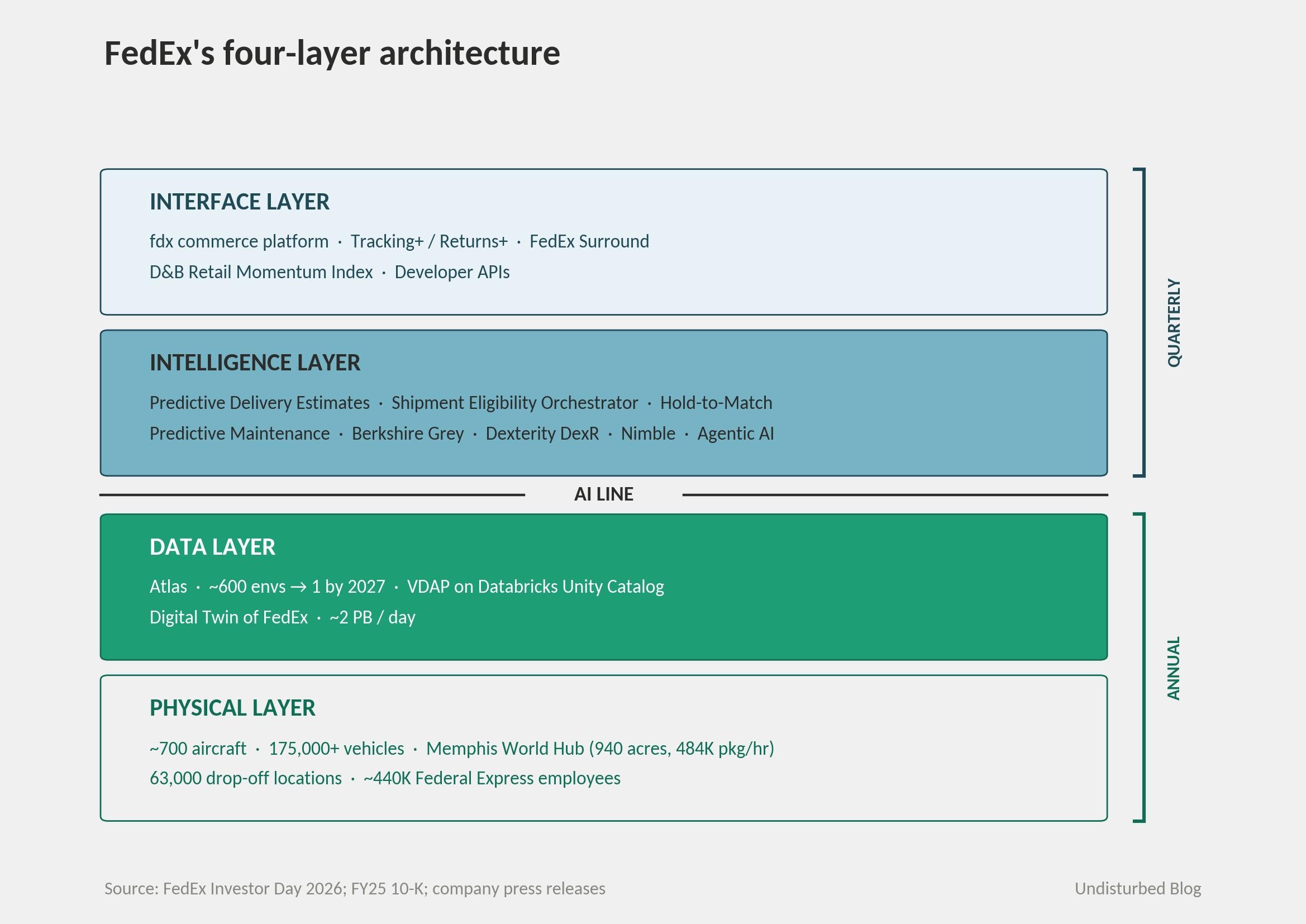
Read the diagram top to bottom and the strategy reads itself. The physical layer is the moat. It's also expensive, slow, and politically painful to change. The data layer takes years to consolidate — Atlas, the program to collapse roughly 600 distributed analytics environments into one, won't be done until 2027. But the intelligence and interface layers ship on a quarterly cadence: fdx announced January 2024, launched September 2024, expanded with Tracking+ and Returns+ in February 2026, all riding on the same physical and data substrate underneath.
The pattern only works if the layers are genuinely separable. That's the part most companies get wrong.
The reason most "AI transformation" programs fail isn't that the AI is bad. It's that companies try to ship a quarterly-cadence intelligence layer on top of a physical layer that hasn't been redesigned to be left alone. Every fast iteration ends up demanding a slow change underneath, and the slow change can't keep up. FedEx's bet is the inverse: stabilize the bottom two layers as long-cycle infrastructure, then let the top two layers run on software time. The architecture is the strategy.
2. How It Actually Works — Three Closed Loops
Loop 1: Routing and ETA
About 17 million packages move through FedEx's global network each day. Each is scanned roughly 25 times. That generates around two petabytes of telemetry daily, fed into a Microsoft Azure environment alongside weather, traffic, and aircraft and vehicle data.
What the AI does with it is the unglamorous work of running a logistics company. Models compute predictive delivery estimates that show up at checkout on merchant sites. The Shipment Eligibility Orchestrator dynamically routes priority freight (healthcare shipments get different treatment than apparel). FedEx Surround monitors the network for weather, geopolitical, and operational risk and recommends interventions. Hold-to-Match consolidates same-address packages to cut last-mile cost.
The closed-loop part matters. Recommendations flow into dispatcher and linehaul-planner dashboards automatically. Actual outcomes — arrival times, service exceptions — feed back into the same models. The current state is "predictive analytics flag potential issues, and our tools suggest reroutes before delays become customer problems," in COO-elect Scott Ray's framing at the February 2026 Investor Day. Humans still make the final operational call. The 2028 plan is to let AI agents handle most of those calls in the routine cases.
The published numbers: pickup-and-delivery costs down 10% in Network 2.0 markets, machine learning cutting delivery times by up to 20%, trailer utilization up 13%, sortation accuracy above 99%.
Loop 2: Sortation and Warehousing
In October 2024 FedEx opened Secondary 25 at the Memphis hub: 1.3 million square feet, four levels, 11 miles of conveyor, 56,000 packages per hour, six-sided scanning tunnels, roughly a thousand cameras, and a Hub Operations Command Center three times the size of its predecessor.
What's interesting about Secondary 25 is what isn't in it: robots. The facility is heavily automated but mostly conveyor-driven. The PM advisor on the project told Supply Chain Dive the team hadn't found robotics that were "heavy duty enough, flexible enough and fast enough to move the freight" reliably. The doctrine, as one FedEx executive phrased it to Fast Company, is that "AI handles scale and speed. People handle complexity and accountability."
Where robotics work, FedEx deploys them aggressively. Berkshire Grey's RPSi systems sort 1,000–1,400 packages an hour at Memphis, Queens, Las Vegas, and Columbus. Dexterity AI's DexR loads trailers, evaluating billions of wall-build options in under 500 milliseconds. In September 2024 FedEx led Nimble Robotics' $106M Series C at a $1B valuation, and is rolling Nimble's autonomous fulfillment into the FedEx Fulfillment network of 130-plus warehouses handling roughly 475 million returns a year.
Loop 3: The fdx Platform
The most interesting layer-three move isn't the AI itself. It's that FedEx packaged the AI for outsiders.
fdx, announced at NRF in January 2024 and launched at Dreamforce in September 2024, is a SaaS commerce platform. Merchants embed FedEx's data and AI into their own systems: predictive delivery estimates on product pages and at checkout, branded tracking and returns, sustainability insights at the package level, real-time visibility through Surround. fdx supports UPS, USPS, and DHL as carriers — FedEx is explicitly running a multi-carrier strategy on its own platform, betting that owning the merchant relationship matters more than locking the merchant to FedEx pickup. Z Supply, a fashion brand cited at launch, reported revenue up 6.33% and mobile conversion up 1.34% after integrating.
In February 2026 FedEx layered on Tracking+ and Returns+ in partnership with parcelLab — AI that automatically answers "where is my order" questions, detects anomalies, and adjusts return policies on the fly. Reported customer outcomes include 42% fewer WISMO inquiries and 85% improvement in retention.
Every fdx module ships on a quarterly cadence. The physical network underneath barely moves. That's the point.
3. The Numbers
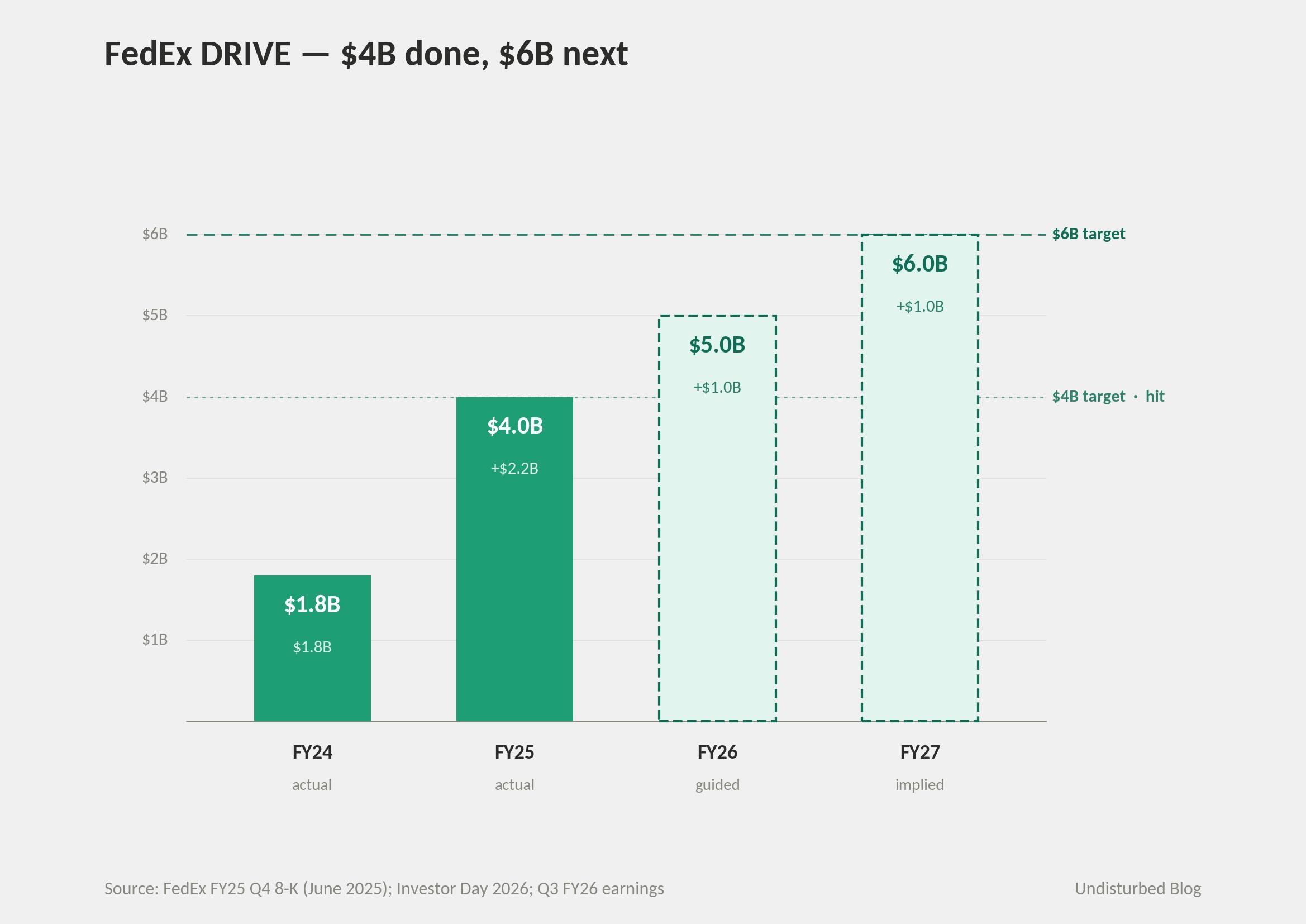
DRIVE was announced in September 2022 and elaborated at an Investor Event on April 5, 2023, with a target of $4.0B in structural cost reduction by FY25 against an FY23 baseline. The program hit it: $1.8B in FY24, $2.2B in FY25, total $4.0B. Management has guided to another $1B in FY26 from DRIVE plus Network 2.0, taking the cumulative target toward $6B by FY27.
Network 2.0 — the integration of the Express and Ground networks under "One FedEx" — was at 25% of volume in May 2025, 35% by March 2026, and is targeted at 65% by peak 2026. Roughly 200 stations have been consolidated; the plan is 475 closures (about 30% of the footprint) by the end of 2027. Pickup-and-delivery costs are reportedly down 10% in optimized markets. Headcount has fallen from roughly 547,000 in 2022 to about 480–500,000 today.
For Q2 FY26 (reported December 2025), FedEx posted revenue of $23.5B, adjusted operating income of $1.61B, and adjusted operating margin of 6.9% versus 6.3% a year earlier. By FY29, management has committed to $98B revenue, $8B operating income, and $6B free cash flow — alongside the AI-agent target of more than 50% of operational workflows.
These are not slogan numbers. They appear in earnings releases, get tracked quarter to quarter, and have a named program owner. A useful filter when reading any large company's AI strategy: ask whether there is a single program that the CFO can quote a savings number for, on a specific date, against a specific baseline. DRIVE clears that bar — $4.0B against an FY23 baseline by FY25, with a 14-domain breakdown and quarterly progress in the earnings release. Programs that fail this test tend to be R&D narratives in disguise. The discipline isn't financial conservatism; it's that without a named owner and a baseline, no one in operations can tell whether a given AI deployment is supposed to replace cost or add capability — and so they do neither well.
4. Is AI a Norm Inside FedEx?
The honest test of whether AI has become organizational is whether it shows up in places that have nothing to do with the technology team. At FedEx, sales reactivated dormant B2B accounts in 14 days using a combined Salesforce Data Cloud and FedEx data view. Customer service deflected 42% of "where is my order" inquiries through Tracking+. Memphis dock managers see live load factors with weather and congestion overlays on their tablets. Software teams are deploying agents that write, test, and review code. Around 300,000 employees are being put through AI retraining.
The substrate for all of this is the data layer. VDAP — the Value Driven Analytics Platform built on Databricks Unity Catalog — has 2,800-plus enterprise users, 77,000-plus queries, 220-plus workspaces, and 1,300-plus governed tables. It's not a sandbox; it's where the operating company runs analyses. Atlas, the larger consolidation program, will collapse roughly 600 fragmented environments into one by 2027 — the explicit prerequisite for the 2028 agent target.
There's also a single sentence everyone seems to use. CDIO Vishal Talwar's version: "Every employee and every task across the globe will get adapted to AI and will improve with AI." Subramaniam's version, at the Asia Society in 2025: "The fuel for AI is data, and we move 17 million packages per day." Operational doctrine, repeated upward and downward, with the same core claim: AI is the leverage, but only because the network produces the data, and only because the data is governed.
FedEx Dataworks, the org that holds most of this, was launched in late 2021 under Sriram Krishnasamy after the 2020 ShopRunner acquisition. Krishnasamy was elevated to Chief Digital and Information Officer in mid-2024 and departed abruptly in mid-2025; FedEx framed the exit around the completion of the $4B DRIVE target. Talwar took over in October 2025 and accelerated the agentic-AI roadmap. The handover is worth noting because the strategy survived it. When the executive most associated with an AI strategy leaves, the strategy usually wobbles. It didn't wobble at FedEx, and that's the more interesting fact than either the appointment or the exit. The reason it didn't wobble is that the doctrine sits one layer above the org chart — in the 1978 sentence, in the DRIVE program structure, in the data architecture choices made before either Krishnasamy or Talwar held the role. A useful diagnostic for any AI strategy: imagine the person currently leading it leaves tomorrow. If the program loses coherence within a quarter, the doctrine isn't real yet — the executive is.
5. Why This Answer Fits FedEx (and Won't Transplant Cleanly)
In 1978, in a Fortune profile, Fred Smith said something that has been repeated by every FedEx CEO since: "The information about the package is as important as the package itself." That is a 47-year-old sentence. It built COSMOS in 1979, the first real-time package tracking system in the world. It built PowerShip in 1984. It put package tracking on the web in 1994. It justified the ShopRunner acquisition in 2020 and the launch of fdx in 2024.
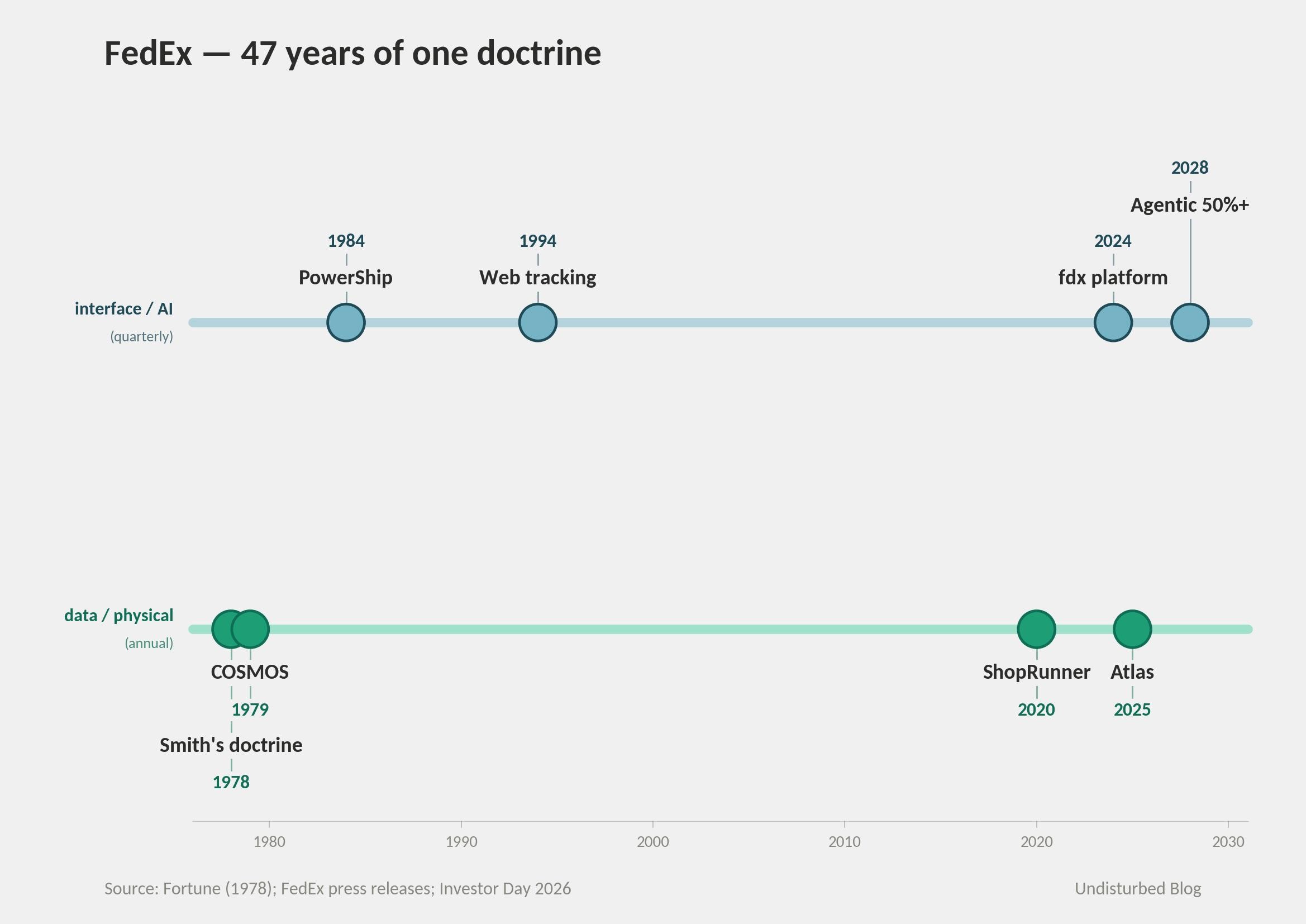
Doctrine of that vintage is not something a competitor can manufacture in a five-year strategy cycle. It's also why FedEx's Make-or-Buy pattern reads cleanly across decades: own the physical network, absorb digital fast.
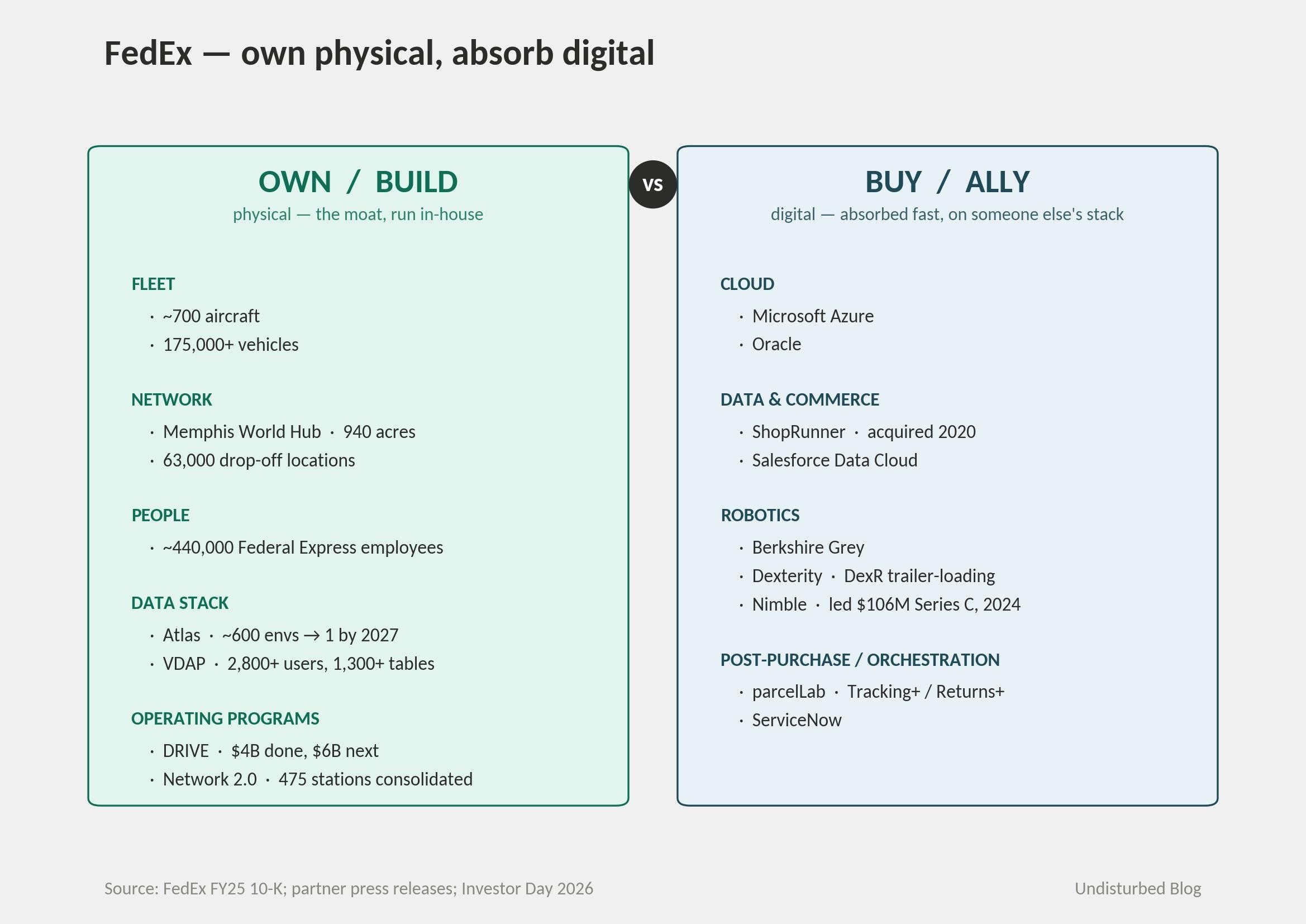
The physical assets are wholly operated. The digital substrate is hybrid cloud (Azure plus Oracle) after the "zero data center, zero mainframe" transition Rob Carter ran before retiring in 2024. The robotics, the AI tools, and the post-purchase software all came in through acquisition or strategic alliance — Berkshire Grey, Dexterity, Nimble, parcelLab, ServiceNow, Microsoft.
The inflection point is more circumstantial. Four pressures hit at once. Subramaniam took over from Smith in June 2022 — only the second CEO in FedEx history. Demand collapsed in late 2022 as e-commerce normalized. Amazon Logistics overtook FedEx in U.S. parcel volume (6.7B versus 3.6B in 2025) and is built natively on AI infrastructure. And the long-deferred integration of Express and Ground became politically possible because the new CEO had no ego invested in the old structure. Take any one of those pressures away and DRIVE doesn't pass internally.
That's the part that doesn't transfer. A company with a thinner doctrine, less proprietary operational data, no native-tech competitor pressing it, and a sitting CEO with a long tenure cannot simulate this inflection by force of will. The four-layer architecture is replicable. The conditions that made it actionable at FedEx in 2022 are not.
It's tempting, reading a case like this, to focus on the architecture and assume that's what travels. The architecture is the easy part — anyone can draw four layers on a slide. What doesn't travel is the activation energy: the specific combination of pressures that lets a CEO push a $4B cost program through a 500,000-person organization without it dying in committee. Strategy frameworks tend to under-weight this because activation energy isn't transferable as a slide. But it's almost always the binding constraint. The honest version of "what to learn from FedEx" is less about the four layers and more about recognizing whether one's own four pressures are aligned, and being willing to wait if they aren't.
6. Four Conditions This Pattern Needs to Travel
These are the four pressures any company has to feel before this pattern is real, not aspirational. They map to the conditions that activated DRIVE inside FedEx.
On the substrate. A company needs to know how many distinct analytics environments it runs today and have a named program with a date to consolidate them. FedEx is collapsing roughly 600 to one by 2027 because agentic AI on fragmented data produces fast garbage. A "data lake initiative" is not the same thing.
On the P&L. AI investment has to show up as a line item the board and IR track quarter to quarter. FedEx frames AI as an operating-margin lever inside DRIVE, not as innovation R&D. The difference matters when the program enters year three and someone asks why the spending continues.
On the doctrine. There has to be a one-sentence statement about what AI does and what people do that every level of the company would say the same way. FedEx's version — "AI handles scale and speed; people handle complexity and accountability" — is the descendant of a 1978 line. A doctrine that can't survive a CDIO transition isn't a doctrine.
On the timing. The four pressures — new leadership, cost-structure crisis, native-tech competitor, organizational integration mandate — actually have to be hitting at once. If three of four are missing, this pattern won't pass internally regardless of how well-argued it is. If all four are present and the company isn't moving, the window is closing faster than the boardroom thinks.
7. Where It Goes Next
Three trajectories are worth tracking. First, fdx as a multi-carrier commerce platform expanding internationally — already extended to Europe with Returns+, with Salesforce, Shopify, and Etsy integrations deepening. Second, FedEx Dataworks selling operational data externally as a product. The Dun & Bradstreet Retail Momentum Index launched in February 2026 is the first real signal: an external index benchmarked against the U.S. Census Bureau's retail figures, productizing the physical movement data FedEx generates anyway. Constellation Research's read is that data products and software platforms carry materially higher margins than the capex-heavy network — and FedEx now has a route to harvest both.
Third, the FedEx Freight spinoff (NYSE: FDXF, planned June 2026) sharpens the focus. Freight leaves with its own technology stack and roughly $8.7B in revenue. The remaining FedEx becomes a cleaner expression of the four-layer pattern: one integrated parcel network, one consolidated data platform, one intelligence layer, one customer-facing platform.
The 2028 milestone is the agent one. More than half of operational workflows handled by AI agents, with managers, workers, and audit roles distributed across them, orchestrated by ServiceNow and trained on data governed in Atlas. If it lands, FedEx will be the clearest large-scale instance of the four-layer architecture running at production cadence. If it slips, the slippage will be in Atlas — because the bottom two layers always determine what the top two can do.
References