Hermès
13
min read
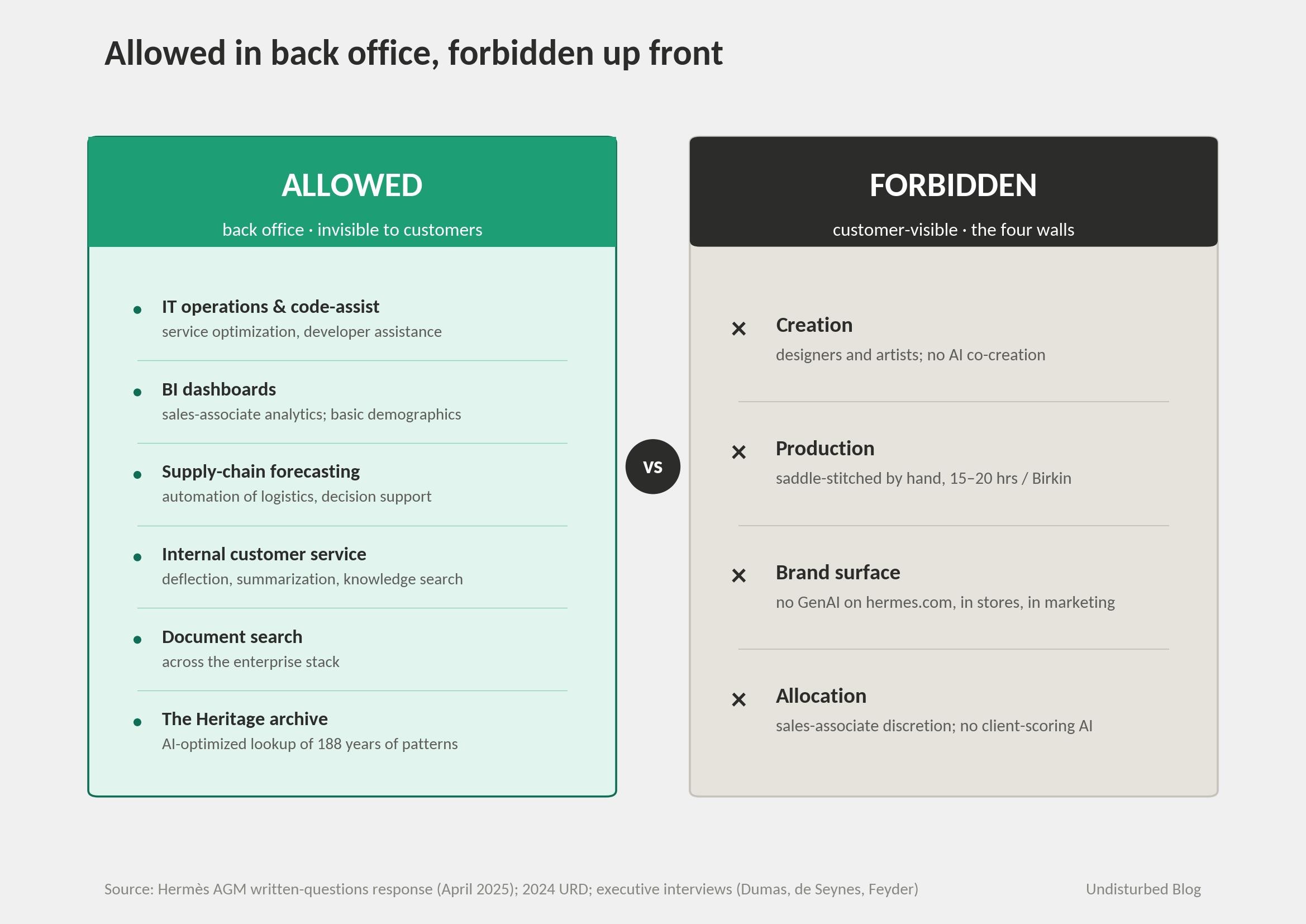
In April 2025, ahead of its annual general meeting, Hermès published an unusual disclosure. The 188-year-old leather house confirmed it uses AI — but only for IT service optimization, BI dashboards, supply-chain forecasting, and internal customer service. "Creation will remain in the hands of our designers and artists." Birkin and Kelly bags are still made start-to-finish by a single artisan over fifteen to twenty hours of saddle-stitching. There is no GenAI on hermes.com. No algorithmic clienteling. Hermès is the most prominent luxury house outside the Aura Blockchain Consortium that LVMH and Richemont co-founded. The same year, the company posted €16.0B in revenue at a 41.0% recurring operating margin and briefly overtook LVMH as the world's most valuable luxury company by market capitalization.
The disclosure reads like a refusal. It is closer to a doctrine. When artificial scarcity backed by visibly human craft is the product, AI must be deployed as an invisible back-office utility — never as customer-visible intelligence. The strategic substrate is the deliberate absence of AI from the parts of the business customers can perceive. Restraint compounds because rivals flooding their value chains with AI involuntarily create the contrast that re-anchors the heritage brand. This is the Hermès posture, and it inverts almost every common assumption about how AI is supposed to land inside a large company.
The pattern
Most large-company AI strategies share one assumption: AI sits on top of a productized substrate, and value comes from getting more AI into more of the business. Build a unified data layer, then run workloads on it. Close the loop between in-house algorithms and the operational exhaust no one else can produce. Re-productize operational data and sell it back to suppliers. Separate fast and slow layers so AI can compound on its own clock. In every case, the direction is the same — more AI, in more places.
Hermès reverses the polarity. The substrate is not a data layer or an operational exhaust or a sovereign cloud. The substrate is the brand-craft sovereign — Hermès as a cultural object, made visibly by human hands, sold under deliberate scarcity, owned by a family on a multi-generational clock. AI is permitted, but only as a utility, only in the back office, and only through someone else's cloud. Four customer-visible surfaces — creation, production, the brand surface, and allocation — are exactly the parts of the business customers see. AI is locked out of all of them.
This is restraint as a moat: AI as back-office utility, human craft as sovereign substrate.
The posture is not "we're not yet ready for AI." Hermès has the resources of a company with a hundred-billion-euro market cap; it is not catching up. Nor is it "AI no" — the April 2025 AGM filing explicitly confirmed AI integration through cloud partners. The posture is restraint as a doctrine — a deliberate, named, governed boundary around where AI is allowed to enter.
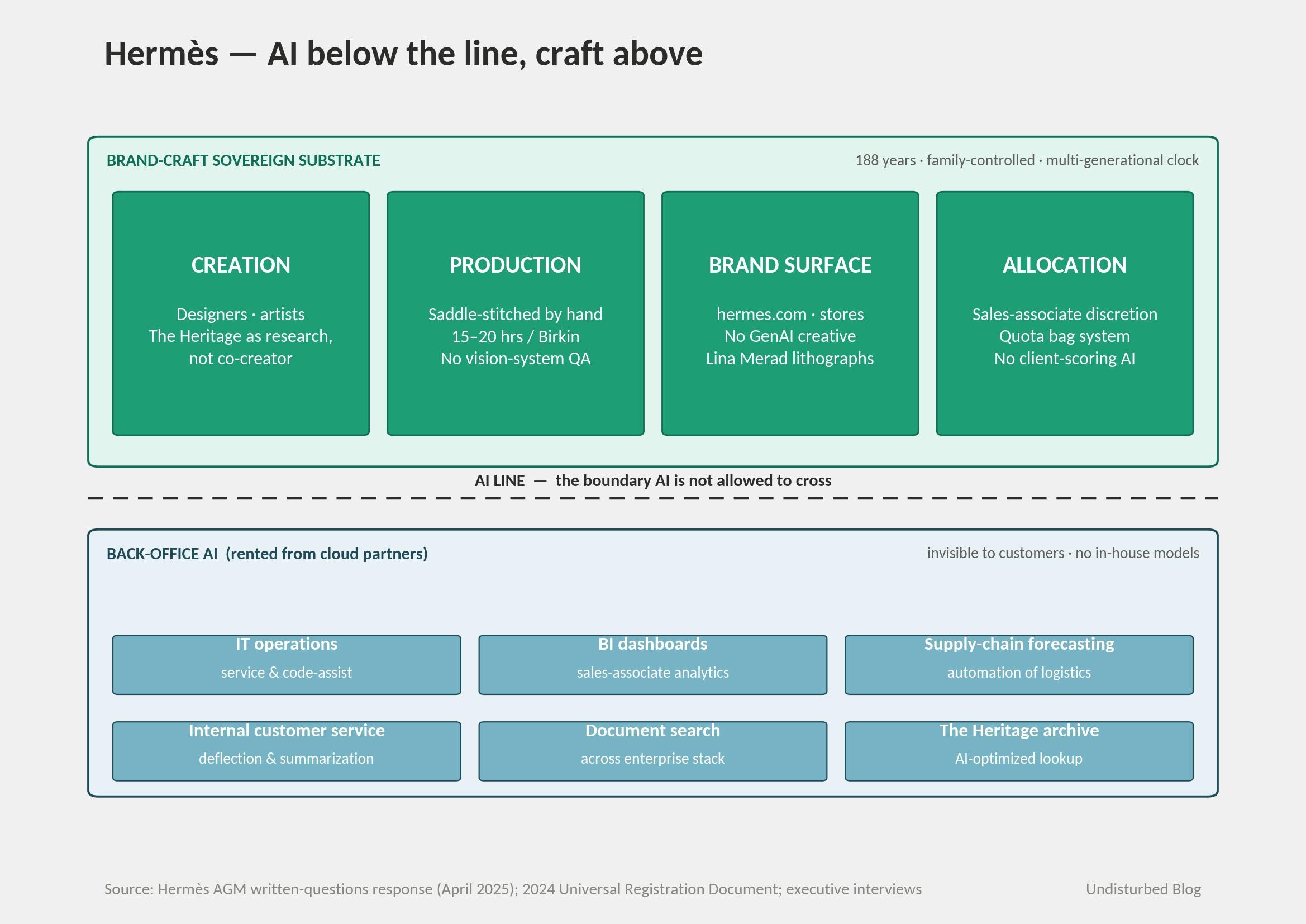
Read the diagram as two horizontal slabs separated by an "AI line" — a deliberate boundary. The brand-craft substrate sits above; back-office AI sits below. Four vertical walls — creation, production, brand surface, allocation — block AI from rising into the customer-visible craft. Hermès itself does not draw it this way. The 2025 AGM filing lists where AI is used, not where it is forbidden. But reading the negative space across the AGM document, the URD, the Pierre-Alexis Dumas interviews, and Guillaume de Seynes' production statements, the four walls reveal themselves as policy, not coincidence.
How it actually works
Three closed loops carry the doctrine.
The supply-chain forecasting loop.
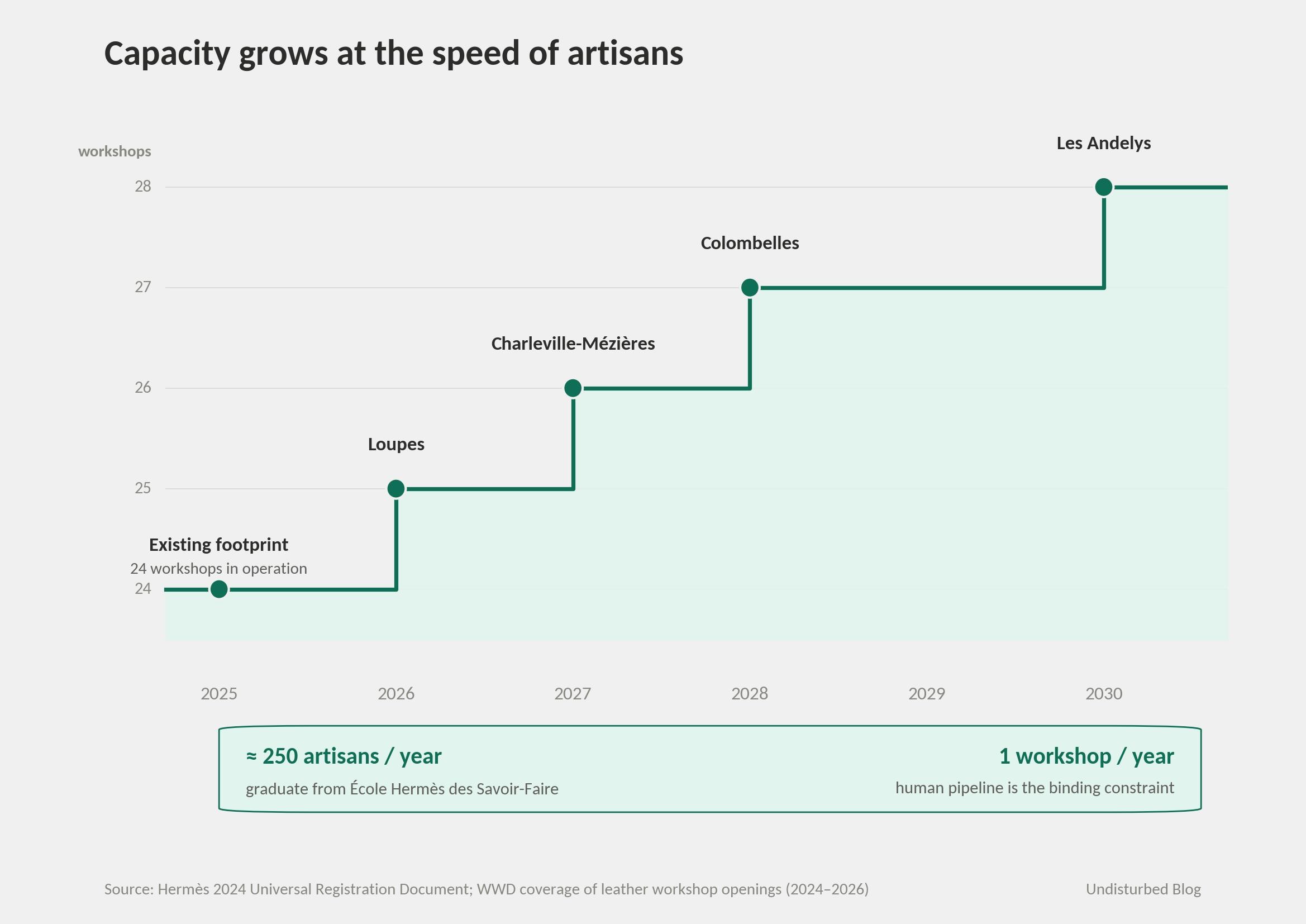
Hermès operates 24 leather workshops in France, with three more on the build-out roadmap through 2030. Capacity expands by roughly one workshop per year. Each new artisan trains for eighteen months through the École Hermès des Savoir-Faire before being allowed to make a Kelly. The system is supply-constrained on purpose; demand exceeds production many times over.
In this regime, AI's most economically valuable use case in retail — matching demand to inventory at SKU and store level — is structurally less valuable here than at any unconstrained luxury house. The closed loop runs the other direction: AI helps Hermès forecast where supply will land, when artisans will graduate, and which workshops will reach steady-state output. The 2025 AGM disclosure names "automation of some logistics processes" and "decision-making support" in supply chain. This is AI optimizing around a fixed supply curve, not AI matching elastic supply to elastic demand.
The loop closes back into the same architecture: AI never says "make more bags." AI says "given that we are making this many bags, here is how to ship them most efficiently." The output is invisible to the customer — but it lets the human bottleneck remain the binding constraint, which is the entire point.
The clienteling loop.
The Birkin/Kelly/Constance "quota bag" system limits each client to two quota bags per year. Local sales associates exercise discretion over which clients receive which bags. The discretion is opaque on purpose; the March 2024 California class action Cavalleri v. Hermès alleged unlawful tying of "ancillary" purchases to bag eligibility, was dismissed twice by Judge James Donato, and is on appeal at the Ninth Circuit as of 2026.
AI could trivially be enlisted to score clients on lifetime value, predict resale risk, or rank prospects. It is not. Ken Feyder, Hermès' Head of IT Americas, told the NRF 2025 Big Show audience that any AI use at Hermès would be deployed with "surgical precision" to align with brand values, and that "customers don't see channels." The disclosed BI dashboards give sales associates customer analytics — purchase history, store visits, basic demographics. The interpretation and the offer remain human.
The loop closes here: human discretion produces opacity, opacity produces mystique, mystique produces resale prices roughly double retail, resale spreads produce the demand pressure that justifies the discretion. An algorithm in the middle would demand transparency in scoring; transparency would dissolve mystique; the loop would break. Hermès sees this. So does its general counsel.
The archive loop.
Pierre-Alexis Dumas, Artistic Director and sixth-generation family member, oversees "The Heritage" — Hermès' fully digitized archive of 188 years of patterns, prints, sketches, and never-released objects. Dumas told NUVO Magazine that The Heritage uses cutting-edge AI that optimizes the database as it is used. Designers can search for prior art, the lineage of a pattern, alternative colorways from 1956.
The loop closes inside the database, never inside the studio: every designer query teaches the archive's AI which adjacencies and pattern lineages matter, which makes the next query sharper, which deepens the institutional memory the next collection draws on. The improvement compounds invisibly to the customer. This is AI as research librarian, not co-creator. The 2025 AGM filing was emphatic: "Creation will remain in the hands of our designers and artists."
Three loops, three back-office AI applications, three customer-invisible surfaces. The pattern is consistent.
The numbers
2025 revenue: €16.0 billion, +9% at constant exchange rates and +6% at current rates.
2024 revenue: €15.2 billion, +13% at constant exchange rates.
Recurring operating margin 2025: 41.0%; 2024: 40.5%. Industry-leading.
Net profit 2025: €4.5 billion.
Q1 2026 revenue: €4.13 billion, +9% at constant exchange rates.
Operational investments 2025: €1.2 billion. Heavily weighted toward stores and distribution (~€769M), with smaller buckets for production capacity and "digital infrastructure, logistics and upstream production."
E-commerce share of revenue: third-party-modelled at roughly $427M GMV in 2024, well under 3% of group revenue. Hermès does not break out e-commerce as a line item.
Online buyers as new customers: ~75% (per pre-pandemic disclosure). No cannibalization of stores.
Production sites in France: 60. Average top-50 supplier relationship: 19 years.
New leather workshops on the roadmap: Loupes 2026, Charleville-Mézières 2027, Colombelles 2028, Les Andelys 2030.
Artisans trained per year: ~250 through the École Hermès des Savoir-Faire (CAP Maroquinerie diploma, 18 months).
April 2025: Hermès market capitalization briefly surpassed LVMH's at ~$276B — the first time a single luxury maison overtook the conglomerate.
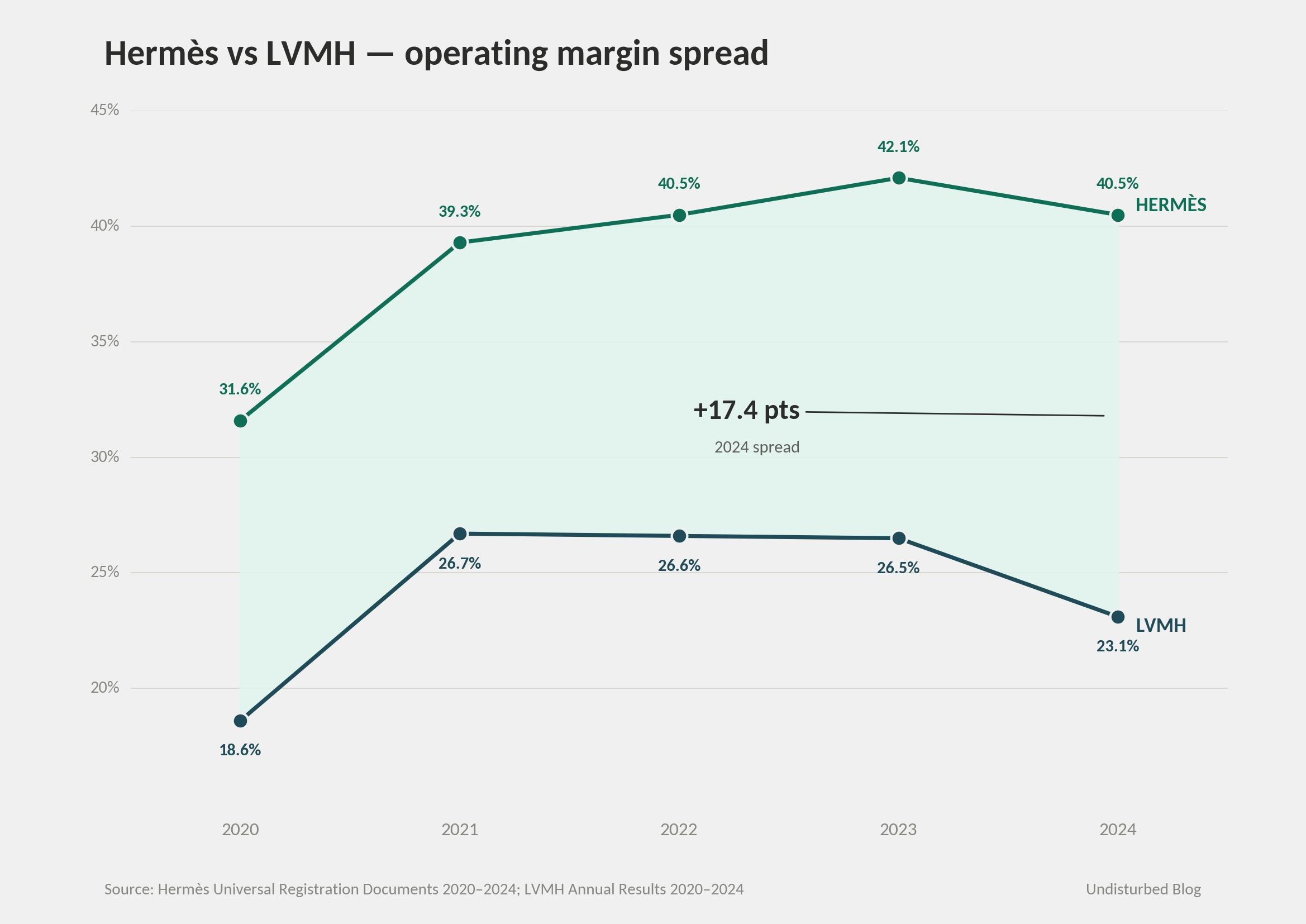
LVMH 2024 comparison: revenue €84.7B (–2%), operating margin 23.1%. Kering 2024: revenue €17.2B (–12%).
Communication expenses: under 4% of revenue (Hermès AGM disclosure) versus industry norms above 8–10%.
The named program owner: Wilfried Guerrand, Managing Director Métiers, Information Systems and Data on the 10-person Executive Committee — a sixth-generation family member who simultaneously runs Hermès Femme. David Coulot is the operational Chief Information & Digital Officer at group level (since September 2021). Ken Feyder is Head of IT, Americas. The deliberate signal in the org chart: technology is one of a family member's portfolios, not a dedicated CIO/CDO/CAIO line. AI is not load-bearing enough to need its own org-chart node.
The 2025 AI Governance Committee — announced in the AGM filing and described as a high-level strategic body — has its mandate written like a defensive perimeter: comprehensive project list, distortion correction, model accuracy/robustness/transparency oversight, impact and confidentiality measurement. The committee approves the scope of AI projects. Nothing in its disclosed mandate sounds like an offensive innovation function.
The 41% margin needs one caveat. It is the easiest number in this analysis to misread. The margin pre-dates the AI question by decades and derives primarily from pricing power, vertical integration, and capacity-constrained scarcity — not from restraining AI. The number that actually carries the directional signal is the spread: Hermès' margin minus LVMH's grew to roughly 18 points in 2024, in the same year LVMH's AI factory accelerated. In a year of intensive AI investment by the conglomerate, the restraint-house out-earned the AI-house by 18 points of margin. Correlation, not causation. But it is the spread investors priced in April 2025.
Is the doctrine real?
By the standard test — multiple use cases on the same substrate, shared doctrine, the texture of how people work — back-office AI is normalized inside Hermès: IT operations, code-assist for developers, BI dashboards, document search, internal customer-service support. The AGM filing names these flatly. Cloud is rented from external partners. The vendor stack is undifferentiated. Across the back office, AI is a normal 2025-vintage enterprise utility.
But the test that matters here is the inverse: is the restraint normalized? Is "AI does not touch creation, production, brand, allocation" a shared doctrine — or one CEO's preference?
The evidence says doctrine. Three signals.
The language is consistent across multiple executives over multiple years. Axel Dumas in interviews ("we don't have a marketing department"), Pierre-Alexis Dumas to NUVO and CBS 60 Minutes (creation in human hands; archive as research tool), Guillaume de Seynes to WWD ("we aren't about to start going for productivity gains"), Ken Feyder at NRF ("surgical precision"), and the AGM filing co-signed by Axel Dumas and Eric du Halgouët ("creation will remain in the hands of our designers"). The doctrine is recited in unison by people whose careers don't otherwise overlap.
The governance ratifies it. The 2025 AI Governance Committee is the first time Hermès' formal governance architecture has named AI — and it named it as a risk function. A company that wanted AI to compound would have created an AI Innovation Council. Hermès created an AI Governance Committee.
The family substrate guarantees succession. The H51 holding (52 family members, 50.2% of capital, 20-year lock-up running through 2031) gives the doctrine a runway longer than any individual executive's tenure. The SCA legal structure and the active-partner role of Émile Hermès SAS prevent doctrinal drift unless the family itself chooses otherwise. The question "does the strategy survive succession?" is answered structurally before it is answered behaviorally.
The harder test is whether restraint holds when no one is looking. The risk surface is mid-management — a regional retail head who could quietly deploy a clienteling tool, a production manager who could pilot a vision-system quality gate, a marketing lead who could test GenAI campaign creative. That none of these has leaked into the press is the real evidence. Doctrine that does not leak through middle management is doctrine that is genuinely held, not just posted on the wall.
Why this fits Hermès
Six older doctrines, consistent across 188 years, predispose Hermès to this posture.
Make, don't buy. Hermès' acquisition history is almost entirely upstream and decades-old: tanneries (d'Annonay 2013, Tanneries du Puy 2019, plus existing French/Italian/Louisiana operations), Saint-Louis crystal, Puiforcat silver, John Lobb shoes. No AI acquisition. No data acquisition. The doctrine "if it matters, we make it ourselves; if we don't make it ourselves, it doesn't matter" applies cleanly. Hermès rents AI from cloud partners precisely because it has decided AI does not matter to the part of the business that matters.
Train, don't automate. École Hermès des Savoir-Faire opened in 2021, expanded to twelve sites by 2025, trains roughly 250 new artisans per year. The constraint on output is the human pipeline, deliberately. Production capacity grows at the speed at which artisans graduate. Investing in human capacity is investing against the productivity arbitrage AI offers.
Scarcity is the product. Two quota bags per client per year. No discounting. Resale prices double retail. The supply-demand gap captures itself in pricing power — Hermès raises prices 6–7% per year and absorbs tariffs without discounting. AI productivity gains in production would destroy the moat by relaxing scarcity. The constraint is the product.
Family control overrides quarterly logic. SCA structure, Émile Hermès SAS as active partner, double voting rights, the H51 lock-up through 2031, ~66.7% capital and 76%+ voting rights for the family. Public-market quarterly pressure does not reach the doctrine. The seventh generation's planning horizon is the seventh generation.
The 2010–2014 LVMH attack hardwired defensive thinking. Bernard Arnault's stealth accumulation of 23.1% via undisclosed equity swaps, the AMF intervention, the H51 formation in response — Hermès' formative recent event was a defensive battle against the very company now leading luxury's AI maximalism. It is not psychological accident that Hermès' AI architecture also reads defensively.
No marketing department, low communication spend. "Our first marketing tool is the price of the product." The same doctrine that explains under-4% communication spend explains why GenAI marketing creative was never on the table. Hermès does not market more, so AI cannot make Hermès market better.
These six doctrines explain why the architecture fits Hermès. They also explain why it doesn't transfer cleanly. The diagram is portable — any business with a brand-craft substrate could draw the same four walls and the same AI line. The activation energy is not.
The posture needs concentrated, generationally patient ownership; a defensible craft mythology with verifiable physical evidence; pricing power that captures the supply-demand gap directly without needing advertising amplification. A public conglomerate cannot adopt the architecture by drawing the diagram, because quarterly earnings calls will demand the AI productivity stories the architecture forbids. The diagram travels. The 188 years and the family lock-up do not.
Three conditions for the doctrine to be real
A useful diagnostic for any company tempted to draw this architecture is whether it can answer a smaller question and a larger one.
The smaller question is operational: what does AI on a unified substrate look like for the back office of the business, and where would visible AI break the brand contract? Hermès rents cloud AI for IT, BI, supply chain, internal CS, and document search. None of it is differentiated. None of it is customer-visible. The boundary is the asset.
The larger question is structural: whether the conditions that make restraint a moat for Hermès are even available. The pattern needs three things together — concentrated ownership long enough to outlast quarterly cycles, a craft mythology with physical evidence customers can verify, and pricing power that captures the supply-demand gap without advertising amplification. Without all three, restraint reads as inertia rather than doctrine.
The final test is whether the metric that would falsify the bet is even visible. For Hermès, it is the margin spread over LVMH; two consecutive years of compression would force a rethink. A business that cannot name its equivalent number does not have the doctrine. It has a preference, which mid-management will leak inside two years.
Where it goes next
The 2025 full-year results announced on 12 February 2026 telegraphed the direction. €1.2B operational investment, weighted toward stores and distribution. The 2026 theme launched in January is Venture Beyond (L'appel du large) — an explicitly anti-algorithmic creative campaign with a hand-illustrated website redesign of twelve lithograph-style drawings by Lina Merad. The Manufacture du Noirmont watchmaking expansion in Switzerland. New stores in Scottsdale, Nashville, Shenzhen, Guangzhou. New leather workshops scheduled through 2030. The roadmap is the same roadmap as the last twenty years, just at slightly larger scale.
What is not announced is the more interesting list. No GenAI consumer product. No foundation-model partnership. No data-monetization play. No AI-augmented design tool. No clienteling algorithm. No Aura Blockchain Consortium membership; Hermès remains the most prominent luxury house outside it. No Digital Product Passport partnership.
This is not blanket digital rejection. Hermès won the MetaBirkins trademark trial in February 2023 (jury award $133K, appeal pending at the Second Circuit), and General Counsel Nicolas Martin signaled at trial that NFTs and blockchain remain a possible tool for Hermès — on its own terms, on its own timeline. The same posture extends to AI: hold the option, refuse the herd.
Two developments would force Hermès to revisit the doctrine.
The first is craft-augmenting AI. If a peer brand deploys a capability that demonstrably increases craft quality — a vision system that catches micro-defects human stitchers miss, deployed openly as a quality enhancer rather than a productivity tool — restraint stops being a moat the moment AI becomes craft.
The second is generational drift. The seventh-generation Hermès family includes members of the Wilfried Guerrand age cohort and younger; the H51 lock-up enforces ownership concentration but does not enforce doctrinal continuity. If the seventh generation reads AI more permissively than the sixth, the posture can shift inside a single succession.
For now, the bet is symmetric to LVMH's. LVMH bets that AI productivity compounds faster than brand dilution. Hermès bets that brand sovereignty compounds faster than AI productivity disadvantages. As of February 2026, by 18 points of operating margin and a market cap that overtook the conglomerate's, Hermès' bet is winning. That is not a permanent verdict. But it is a verdict.
References