United Airlines
13
min read
United Airlines is mid-flight on the largest fleet renewal in commercial aviation history. A 270-aircraft order in 2021. One hundred widebodies in 2022. Expansions in 2023. A forward order book of roughly 700 jets sitting on top of a 1,000-aircraft fleet. Starlink is rolling out at more than a dozen mainline planes a month. Kinective Media monetizes 108 million traveler profiles across roughly 100,000 seatback screens, headed for 300,000 by mid-2027. AI runs on every operational surface where the objective function is clear — and CFO Mike Leskinen has put a number on it: management headcount at headquarters is 4% lower than the prior year because of AI, with another 4% planned for 2026.
The doctrine behind all of this, as Skift's Edward Russell synthesized it, is AI for optimization, humans for judgment. When physical assets turn over every twenty-five years and intelligence turns over every quarter, the strategy is the separation. Four layers running on their own clocks, each handing cleanly to the next, with the AI line drawn deliberately between intelligence and the data underneath.
The Strategy in One Picture
United operates on four clocks at once.
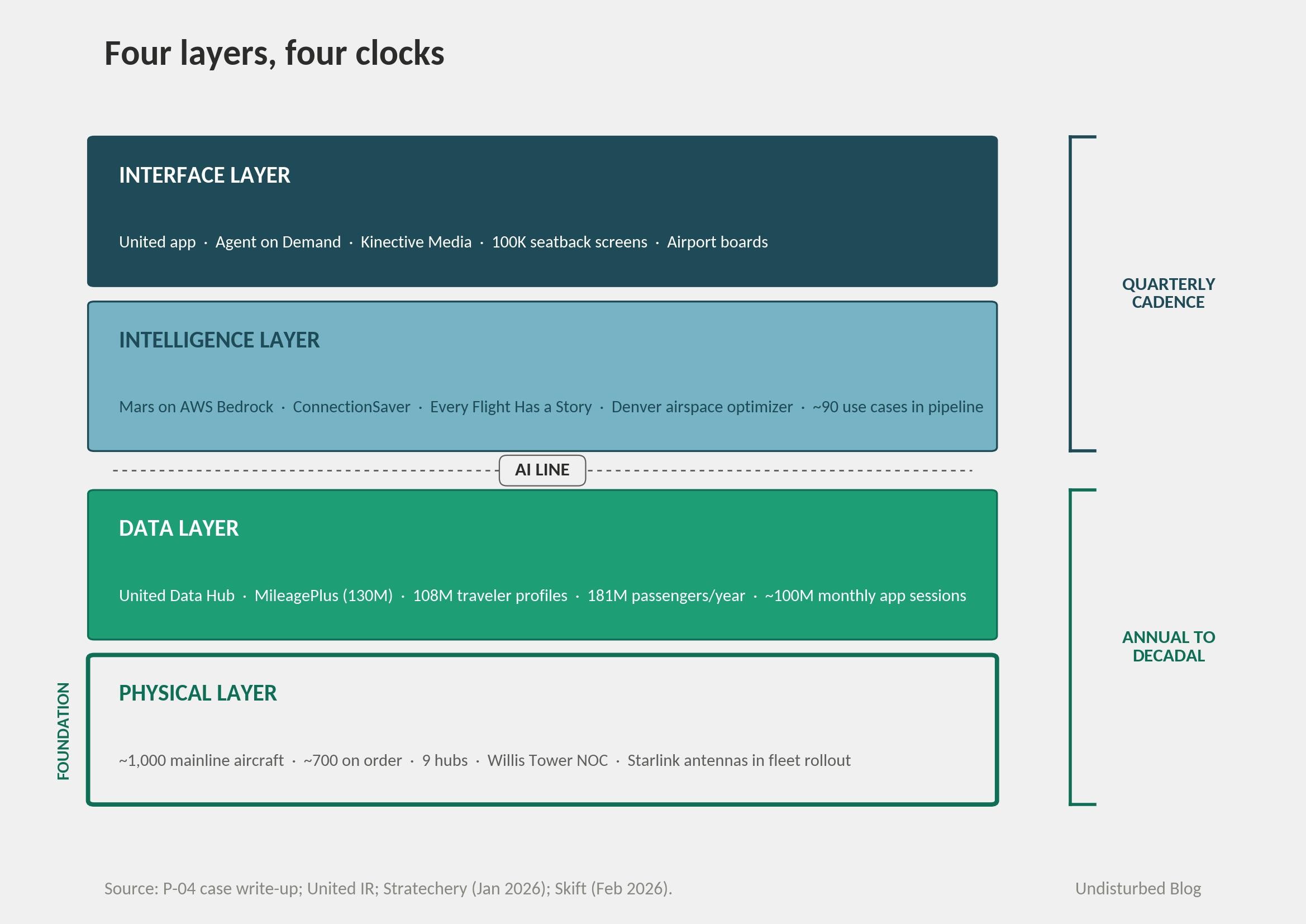
Airlines have always been asset-heavy, but most of them run their technology the same way they run their fleets — long procurement cycles, multi-year vendor contracts, software inheritance from the SHARES era of the 1960s. United is doing something different. The lower two layers, physical and data, move on annual to decadal time. The upper two, intelligence and interface, iterate quarterly. The horizontal line between intelligence and data is the AI line — the place where statistical models live, fed by the data underneath, executing through the interfaces above.
The same shape recurs in adjacent industries. FedEx uses it for parcel logistics. JPMorgan uses it for finance. United's variant is asset-heavier than either. The physical layer is twenty-five-year aircraft, not ten-year trucks or five-year servers. The whole strategy depends on getting the cadence separation right.
One framing note. United itself doesn't draw the four-layer picture this way. The "AI for optimization, humans for judgment" line is Skift reporter Edward Russell's synthesis of Kirby's doctrine, not a Kirby quote. Kirby's verbatim language is more clinical: AI works where "we have massive data sets" and "it's pretty easy to define the objective function" (Stratechery, January 15, 2026). The synthesis holds because the doctrine is consistent across every public appearance — deploy AI where the objective is well-defined, withhold it where independent judgment matters, and never confuse the two. That is what makes the four-layer reading defensible.
How It Actually Works — Three Closed Loops
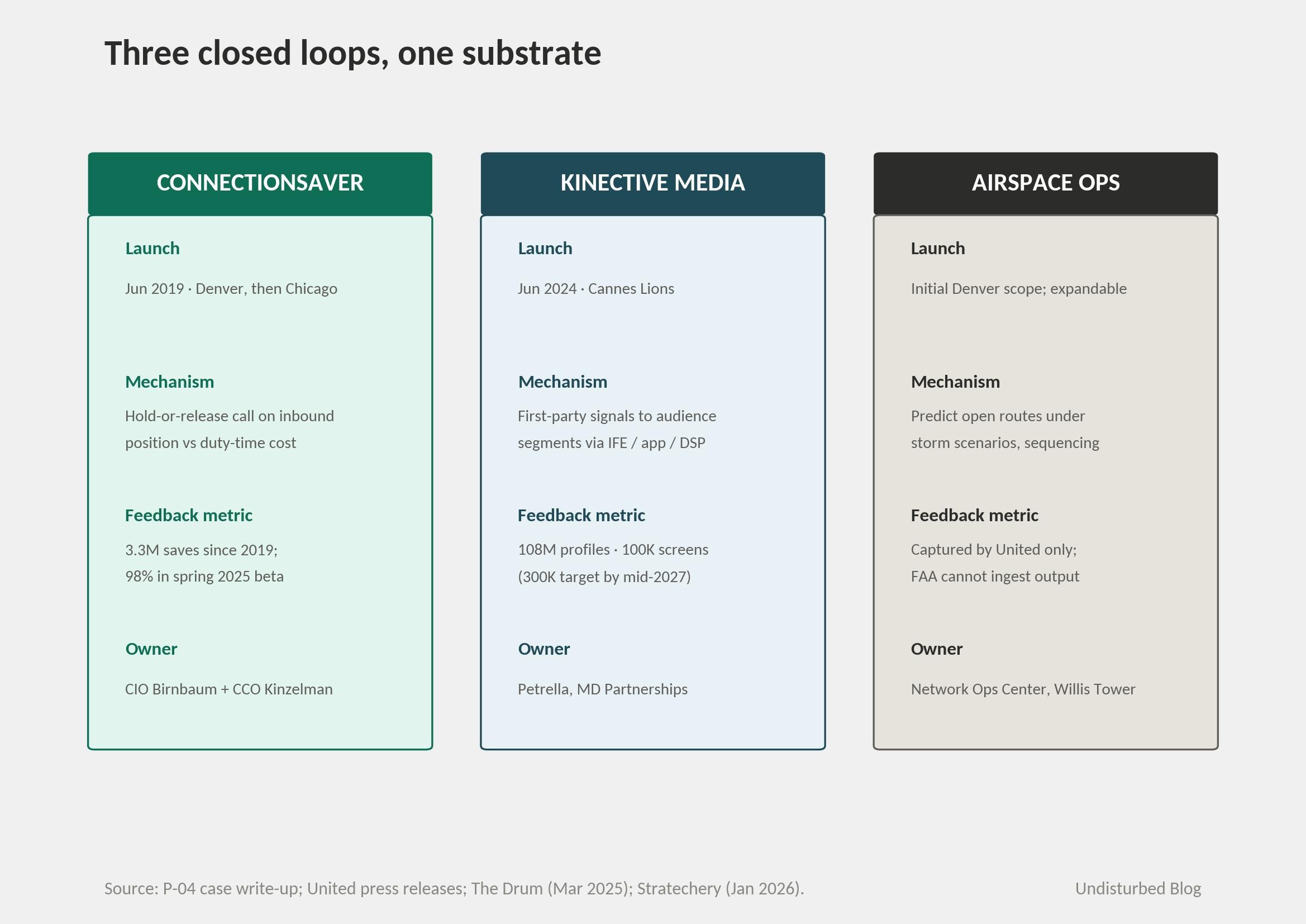
Closed loops are the test. Anyone can run a pilot. The harder thing is having the loop run continuously, in production, with real operational consequences and real feedback into the model.
Loop A — ConnectionSaver
Launched June 2019 in Denver, with rollout to Chicago and additional hubs through the rest of that year. The mechanism: continuously scan inbound flight positions and connecting passenger lists, weigh the cost of holding the departing flight a few minutes against downline impact on already-boarded passengers and crew duty time, and either auto-recommend a hold (typical: six minutes) or release the flight on time. Output goes to the gate agent and a personalized text to the connecting customer with arrival gate, departure gate, walking time, and a map.
The metric that matters: 3.3 million customer connections saved cumulatively from 2019 through June 2025. A spring 2025 beta of an enhanced in-app dashboard on 350,000 passengers hit a 98% successful-connection rate. The owners are CIO Jason Birnbaum on the technology side and Chief Customer Officer David Kinzelman on the customer-facing side.
Loop B — Kinective Media
Launched at Cannes Lions in June 2024. United's first-party MileagePlus and booking data — roughly 120 targetable signals across 108 million anonymized traveler profiles — feeds audience segments delivered through the United app (roughly 100 million sessions a month), 100,000 seatback screens, lounges, and programmatically via Magnite SpringServe and Yahoo's DSP. Engagement and conversion measurement runs through clean rooms (LiveRamp). The output is segment refinement and renewal of brand contracts.
The framing is deliberate. Mike Petrella, the managing director who built the partnerships side, has been precise about the category: "Retail media? No. It's commerce media." The distinction matters. Retail media is point-of-sale. Commerce media is the journey. And United, with three-and-a-half hours of average captive attention per flight, owns more of the journey than anyone except maybe a hotel.
The financial trajectory is honest. CFO Mike Leskinen told the Q3 2024 earnings call that Kinective will only generate "a little bit of money" in 2025, with real acceleration in "'26 and beyond." JetBlue signed up to use the same tech stack in 2025 — proof that the playbook is replicable. In Stratechery, Kirby framed the advertising business as "icing on the cake. It's not the cake."
Loop C — Airspace Optimization
Decades of weather, ATC, and operational data feed an AI model that predicts which routes will be open under storm scenarios. The recommendation goes to the dispatcher and the Network Operations Center. The decision flows back into the model.
Kirby in Stratechery described the system as decades of weather and route data feeding a sequencer that, in his words, "can make the Denver airport dramatically more efficient" — and is extensible to every airport. There is a constraint. The FAA cannot ingest United's output, so the optimization is captured only by United, in selected sequencing decisions, not industry-wide. That bottleneck is the one place the four-layer strategy hits the limits of a network the airline doesn't own.
A fourth use case is worth noting briefly. Kirby at the Bernstein Strategic Decisions Conference in May 2025 said AI is "more accurate and faster than humans" at parsing and updating labor contracts. It is more workflow tool than closed loop today — there is no operational feedback signal disclosed publicly — so it sits adjacent to the three real loops rather than as a fourth.
The Numbers
Q3 2025 revenue was $15.2 billion, up 2.6% year-over-year. Diluted EPS was $2.90. Loyalty revenue, which is the MileagePlus line, was up 9%. The company crossed 5,000 peak daily flights for the first time, against a #2 industry on-time finish.
Q4 2025 revenue was $15.4 billion — the highest quarterly revenue in United's history. Full-year 2025 revenue was $59.1 billion, also a record. Net income was $3.4 billion. Operating cash flow was $8.4 billion. Free cash flow was $2.7 billion. 181 million passengers — also a record.
Q1 2026 revenue was $14.6 billion, up 10.6% year-over-year. Premium revenue was up 14%, loyalty up 13%, business up 14%. The company is now guiding to record 2026 earnings on top of record 2025.
But the number that matters most for an AI strategy reading is the one CFO Mike Leskinen disclosed on the October 16, 2025 earnings call: management headcount at United's headquarters is 4% lower than the prior year specifically because of AI, with a planned additional 4% reduction in 2026. By Skift's count, United is the only major US carrier to attribute headcount reductions to AI on an earnings call.
What makes that 4% disclosure load-bearing is what surrounds it. The Q3 2025, Q4 2025, and Q1 2026 earnings calls are notable for what they don't say. The phrases "artificial intelligence" and "AI" almost never appear in the prepared remarks. United is not running an AI marketing campaign; it is running a productivity story. Most CEOs talk about AI without booking the savings. United declines to talk about AI but books a number that — by being attributed explicitly to "process changes and using AI" — commits the airline to a P&L line. Four percent is not big. Four percent on top of four percent compounds. That compounding is the proof that the architecture has crossed from experimental into operational.
The other numbers that justify the architecture: ConnectionSaver at 3.3 million cumulative saves since 2019, with that 98% beta success rate. Every Flight Has a Story, the GenAI delay-explanation system, delivered a 6% lift in customer satisfaction and over 100,000 push notifications, with roughly 90 additional use cases identified in the Mars/Bedrock pipeline. Agent on Demand's launch case projected $182 million to $212 million in annualized labor savings (2022).
Capex runs at roughly $7–9 billion a year for several years on aircraft. List value of the firm orders alone is north of $50 billion. Kirby has emphasized customer-experience investment separately at over $1 billion a year — including $100 million on wine, with the same level planned for 2026.
Is AI a Norm Inside United?
Multiple use cases on the same data substrate is the test. United runs ConnectionSaver, Every Flight Has a Story, baggage recovery, customer-care email copilots, an internal "United ChatGPT," procurement LLMs, manager-employee comms LLMs, NOC shift-handover summarization, labor-contract update tools, the Denver airspace optimizer, and the Kinective audience-segment engine — all on the same Mars (AWS Bedrock) ML platform sitting atop the same United Data Hub data lake. Birnbaum's language: "We had a pretty mature AI practice." The roughly 90 use cases identified in the pipeline aren't research projects; they are competing for engineering resources against a backlog ranking system.
The CIO matters here. Jason Birnbaum joined United in September 2015 as VP of Operations and Employee Tech, became SVP of Digital Tech in 2019, and CIO in July 2022. His doctrinal line, surfaced repeatedly in CIO.com coverage: "The airline that makes decisions fastest wins." His unit runs roughly 1,500 employees plus 2,000 contractors. The cloud migration off the SHARES Fortran reservations system from the 1960s — Kirby called it "hundreds of millions of dollars" of program work — is now in its final phase, slated for completion in 2026.
Strategy that depends on a single CEO is brittle. United's doesn't, and that's the deeper test of normalization. Birnbaum's data-architecture rebuild started in 2015–2019, before Kirby was CEO. The SHARES decommissioning was inherited, not initiated. The original Polaris cabin launched under Oscar Munoz. Kirby's distinctive contribution was eliminating delay codes — a culture change that paired with the data architecture investment to make Every Flight Has a Story possible. The four-layer architecture is structurally embedded, not personally driven. If Kirby retired tomorrow, the loops would keep running. That is a different kind of strength than a charismatic leader articulating a doctrine — and it's the one that lasts.
The Delta and American comparison is instructive. Delta picked Amazon Project Kuiper for in-flight Wi-Fi, with service expected around 2028 — years behind United's Starlink rollout. American's AI work is real but does not have a CEO articulating doctrine on a podcast. Neither has stood up an airline-industry-first commerce media network. Neither has the explicit headcount-AI attribution. United is not the only US airline doing AI. It is the only one that has put the layers in print.
Why This Answer Fits United
Scott Kirby has the unusual background to articulate this doctrine plainly. Air Force Academy with a double degree in computer science and operations research. Pentagon analyst writing Fortran and managing Unix systems. Master's in OR from George Washington. Sabre Decision Technologies, then American Airlines Decision Technologies. Network and revenue management at America West from 1995. President of US Airways from 2006, American from 2013, United from 2016. CEO since May 2020. He is the rare US airline CEO with thirty years of network-and-revenue-management operating experience and the technical literacy to write code himself. That's why he can say AI is "a wonderful tool for many classes of problems…it's pretty easy to define the objective function" and have it land as doctrine rather than buzzword.
The make-or-buy pattern is consistent.
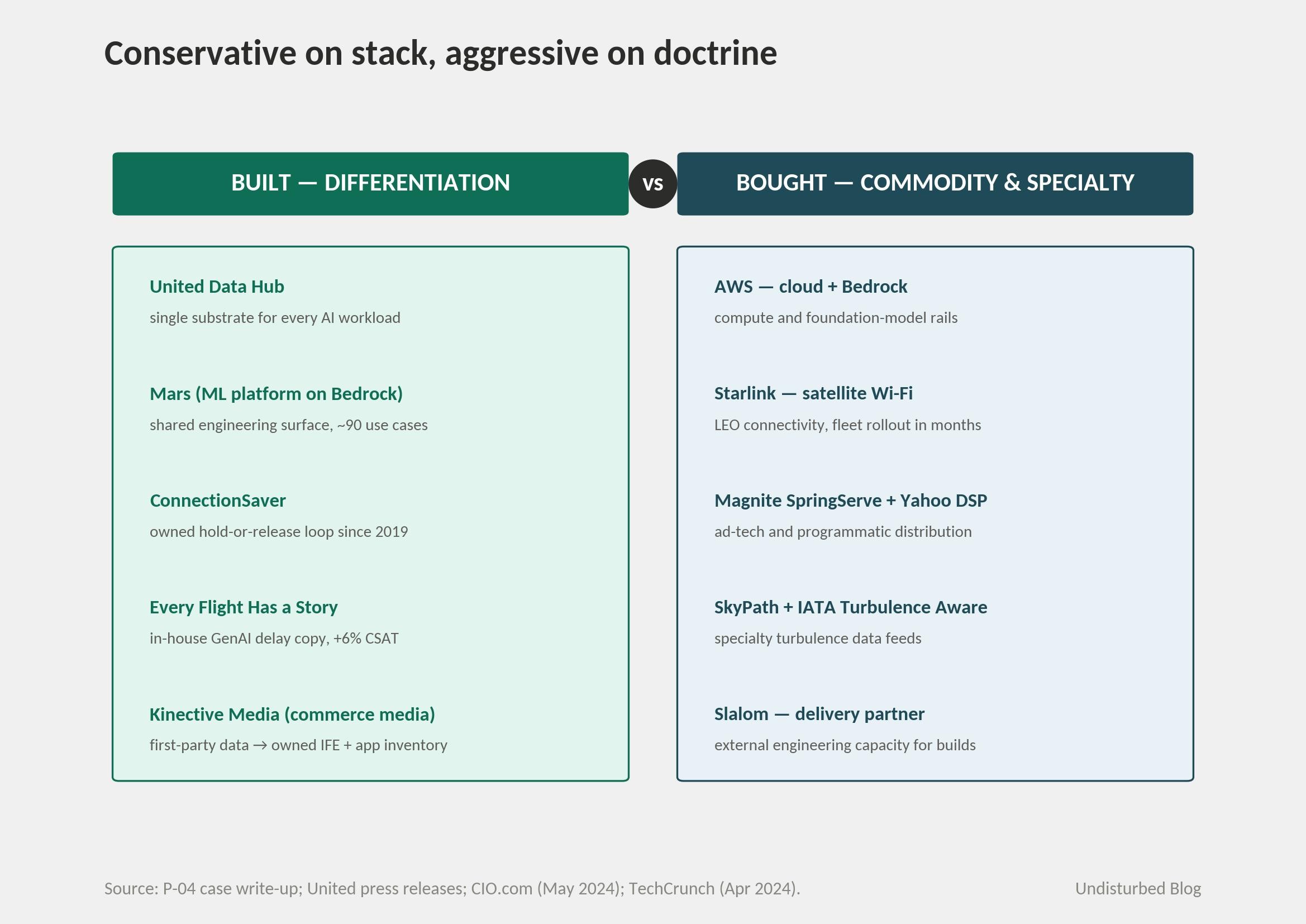
United builds the differentiation layers — United Data Hub, Mars, Every Flight Has a Story, ConnectionSaver, the Kinective business model. United partners on commoditized infrastructure and specialty data feeds — AWS for cloud and Bedrock, Starlink for satellite Wi-Fi, Magnite SpringServe for ad-tech, SkyPath and IATA Turbulence Aware for in-flight turbulence data, Slalom for delivery. The pattern is conservative on stack and aggressive on doctrine.
Why now is straightforward.
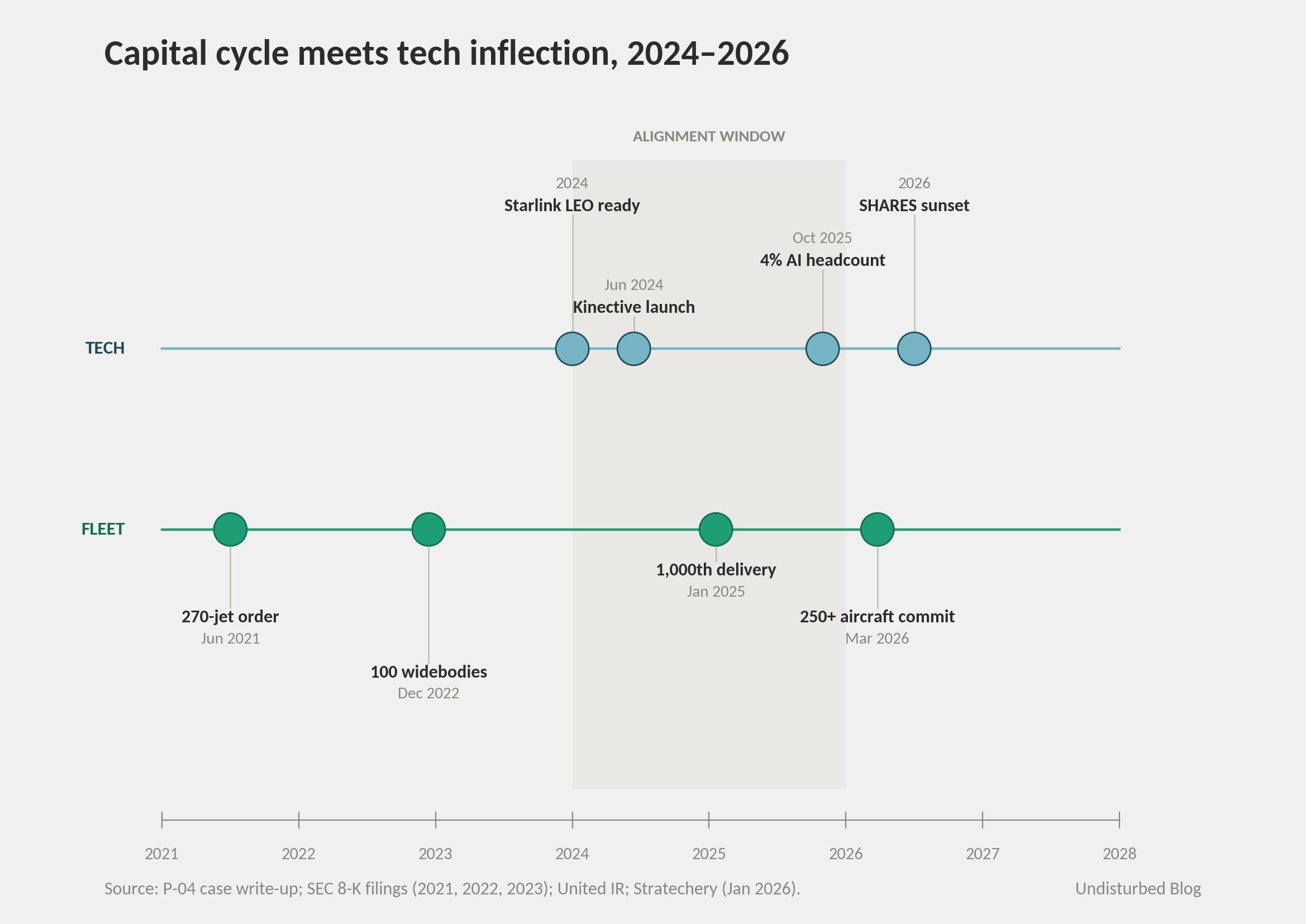
The capital cycle locked in. The 2021 270-aircraft order and the 2022 100-widebody order happened during a once-a-decade window when peers retreated. Starlink LEO availability arrived in 2024. Generative AI hit at exactly the moment the legacy SHARES decommissioning entered its final phase. Union contracts renegotiated in 2024–2025 opened the door to operational workflow changes — the robocall-instead-of-phone-call story Kirby tells about Newark crew scheduling is the kind of thing that only became possible with the new contracts.
This is the line that travels and the line that doesn't. The architecture transfers — four-clock layer separation, "AI for optimization, humans for judgment" as a doctrinal posture, the discipline of refusing to deploy AI where independent judgment is required, the commerce-media playbook. Other airlines, other asset-heavy operators, can carry these. The activation energy mostly doesn't. United's roughly 700-aircraft order book requires investment-grade balance-sheet capacity that few peers have. The MileagePlus dataset, accumulating since 1981 and analyst-valued above $22 billion in 2020, cannot be cloned. The Willis Tower NOC, with its full-floor narrowbody/widebody bridge layout, is one of one. Kirby's mathematical literacy and three-decade revenue-management background is one of one. What an executive reader can learn from United is the architecture. What they cannot import is the prior twenty years of capital and operational compounding that earned United the right to that architecture.
Where It Goes Next
Capacity. The March 2026 announcement committed to 250-plus aircraft additions by April 2028 — the most by any airline in any two-year period. Thirty-three Elevated 787-9s with Polaris Studio suites by 2028. The first one entered SFO–Singapore service on April 22, 2026.
Premium. Polaris Studio rolls out across long-haul flagship routes as the Elevated 787-9s arrive — twenty Dreamliner deliveries in 2026 against eight in 2025, then thirty Elevated 787-9s in fleet by end of 2027 and thirty-three by 2028. The new "Relax Row" economy convertible-to-couch debuts in 2027 with a target of 200-plus aircraft by 2030.
Starlink. Full mainline by end of 2027. By February 2026, 1,200 daily Starlink-equipped departures, more than 25% of the network, 7 million-plus passengers carried across 129,000-plus equipped flights. Customer satisfaction with Wi-Fi nearly doubled on equipped aircraft.
Kinective. Mike Petrella in The Drum, September 2025: "By mid-2027, we'll have about 300,000 connected screens. That's when it gets really interesting." Spotify with full login by 2026. JetBlue syndication active. No specific 2026 or 2027 revenue targets disclosed publicly; Leskinen's "accelerate in '26 and beyond" remains the ceiling-setting language.
The agentic AI question is open. Kirby on Stratechery is explicitly skeptical of consumer-facing AI agents that are "designed to tell you what you want to hear, not what you need to hear." No external agent integration has been disclosed. United's stance reads as opting out, for now, of the substrate-as-distribution play — leveraging owned interfaces (app, IFE, gate UI) rather than external aggregators. The Kinective programmatic side is an ad-aggregation play, not a passenger-side agent play. That distinction matters and is worth watching.
Four Diagnostic Lenses
Four lenses for reading any asset-heavy operator's AI posture, derived from the United case.
1. Whether the data sits on a unified substrate that AI can actually run on. United's Data Hub plus Mars on Bedrock is the prerequisite. The 90-use-case pipeline only exists because the substrate exists. Operators without that substrate spend more on integration glue than on models — and every project becomes a one-off.
2. Whether AI's productivity impact has a number on it. United disclosed 4% management headcount reduction in 2025 with another 4% planned for 2026. That commits the company to a P&L line. Most companies talk about AI without booking the savings. United declines to talk about AI but books the number. The presence or absence of an attributed number is the cleanest signal of whether the architecture has crossed into operational.
3. Whether AI is a company-wide norm or a collection of isolated PoCs. Roughly 90 use cases on the same substrate, ~1,500 engineers plus contractors, a CIO with a doctrinal line ("the airline that makes decisions fastest wins"), shared training and an annual hackathon — that texture is different from a single department running a single model. The norm question is what makes the architecture survive a CEO change.
4. Whether the alignments are arriving now. United's capital cycle, Starlink's availability, generative AI's inflection, the SHARES decommissioning, and the union-contract renegotiation window all fell into place in 2024–2025. Operators that identify which alignments their industry is in right now — or about to be in — separate strategies that compound from strategies that arrive late.
References